
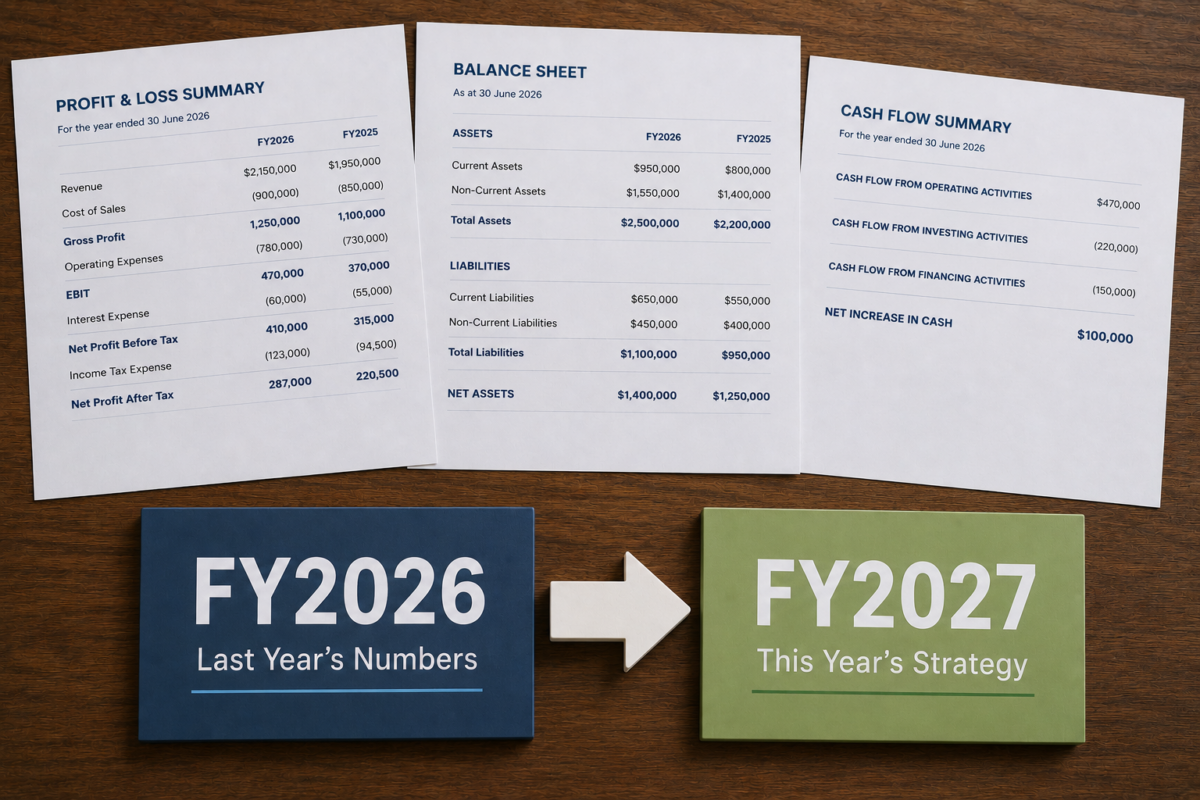
The end of the financial year often feels like a rush to the finish line. There’s a flurry of activity as tax returns are prepared, financial statements are finalised and the year is put behind you.
But it’s also the ideal time to look ahead. Last year’s financial performance holds some of your most valuable business intelligence, offering insight into what worked, what didn’t and where the opportunities lie.
Here are five ways to turn last year’s numbers into practical strategies for the year ahead.
1. Analyse the numbers
Start with the fundamentals: your profit and loss statement, balance sheet and cash flow statement. These three documents tell the story of how your business performed over the past 12 months and reveal far more than whether you made a profit.
Are your margins holding up or quietly shrinking? Is your cash flow consistent or are there gaps that point to collections issues or seasonal fluctuations? Where are expenses creeping up?
The patterns you uncover can help shape decisions around pricing, staffing and operations and pinpoint the most critical areas to focus on in the year ahead.
2. Identify who (and what) is driving your profit
Revenue doesn’t always translate into a profit, and some clients or product lines can consume far more time and resources than they return.
Look closely at which products, services or clients generated the most profit last year, not just the most revenue. You may find that a small number of clients account for a disproportionate share of your bottom line or that certain offerings are quietly eroding your margins.
With that clarity, you can double down on what’s working, revisit pricing on what isn’t, or redirect your resources towards the opportunities likely to yield greater returns.
3. Set meaningful goals for the year ahead
Last year’s performance provides a reliable baseline when setting targets. Rather than working from gut feel or optimistic projections, you can use actual data to set realistic goals for the next 12 months.
You can set key performance indicators (KPIs) and measurable targets for:
- revenue
- profitability
- cash flow
- client retention
- employee productivity
- operational efficiency
4. Build resilience into your plans
The past few years have shown how quickly global events can disrupt Australian businesses. Tariff uncertainty, supply chain disruptions and geopolitical instability have all placed pressure on costs, profitability and cash flow.
Take time to consider how these factors affected your business over the last year.
Did supplier costs increase?
Were there import delays?
Did customers become more cautious with spending?
From there, you can create a more resilient business strategy that includes:
- building stronger cash reserves
- diversifying your supplier base
- locking in fixed-price contracts where possible
- stress-testing your cash flow under different trading scenarios
5. Make investment decisions with confidence
Business growth often requires investment. Last year’s financial results will influence what your business can realistically support and where capital is likely to have the greatest impact.
Whether you’re considering purchasing equipment, employing additional staff or expanding into new markets, you can ground those decisions in your actual performance data.
It’s also worth identifying where spending could be trimmed. This allows you to redirect resources away from underperforming areas and toward higher-return opportunities.
Conclusion
The end of the financial year isn’t just about closing the books. It’s an opportunity to use what happened over the past 12 months to make smarter decisions for the next 12. Businesses that take the time to reflect on what the numbers are telling them are far better positioned to make confident, strategic decisions about where they’re heading next.